With the popularity of home improvement shows in the last few years, DIY projects are a familiar concept. We’ve all felt the tug to renovate or have spent the capital to plan and complete improvement projects that we can do ourselves in our homes.
What I’m calling DIY fitness follows that same framework. A “Do-It-Yourself” approach to fitness is the activity of stewarding and strengthening your body without the regular employment or 1/1 coaching from a professional.
Admittedly, the DIY fitness journey is never done in absolute isolation. You will always be learning from others, either from videos, podcasts, books, relationships, etc… However, the goal of this learning is for you to be able to develop the base knowledge, skills, and information that you need to take care of your own body.
When not to DIY Fitness
Even the most competent DIYer knows when to call in a professional.
If a home has systemic issues that need further evaluation, it’s best to call in a professional for further evaluation. If there’s a project that requires the advanced skill of a plumber or electrician, the DIYer will save money, time, and pain along the way by partnering with a professional to have the work done.
Same thing goes for your body. If you have a chronic health condition, are recovering from an injury, have regular pain, have musculoskeletal problems, or are completely brand new to fitness, I’d encourage you to seek the advice of your primary care physician and partner with a certified coach before starting any workout plan.
And if you are a healthy and active individual, you will still gain a lot of value in learning from professionals. Some prefer this almost exclusively, and most (especially at the beginning) need some guidance and a plan to help them get started.
My point is this. Even the most experienced DIYer is humble and wise enough to know his own limits. He knows the value of professional advice and will pay for it when needed.
DIY Fitness in the Information Age
We’ve never had as much access to information as we have today. We can step into any realm of information instantly with only a few seconds of internet searching. This access to information makes DIY fitness entirely possible.
Yet at the same time, the overwhelming amount of data makes DIY fitness harder than ever. Discerning the helpful fitness sources from the harmful or ineffectual ones takes work and experience. The fads and charlatans of the fitness industry line the video and search feeds, which turns the fresh springs of information out there into a moldy project.
DIY Fitness – Your Renovation Project
While the swamp of information makes navigating the fitness space harder, it does not make it impossible. We still have immediate access to experts in a variety of fields that no prior generation had access to. We just need to learn how to discern the helpful from the harmful.
Here are some principles that have helped me navigate through all the noise to DIY my own fitness.
Identifying Your “What”
Most DIY projects have a defined objective and scope, like how to remove and replace a bathtub, how to lay down flooring in your kitchen, or how to power wash the siding on the exterior of your home.
The principle applies to DIY fitness. Identifying your objective, or your mission, is the first step in your DIY journey. Do you want to lose weight? Build muscle? Pursue longevity? Increase mobility and flexibility? Reduce pain? Develop strength? Bulk up?
Narrowing in on your objective determines your starting point with your building project.
Clarifying Your “Why”
If the objective is the “what”, the motivation is the “why”. You begin a DIY project for a specific reason. The shower floor has a crack in it. The addition of a bathroom will add value to your home. An open layout of a kitchen adds warmth and space for your family.
Same goes for fitness. You want to lose weight, build strength, or pursue longevity, but what are the underlying motivations?
I write to the Christian guy, and as Christians there are motivations we have to take care of our bodies. Here are some:
- We steward them for God’s glory (1 Corinthians 10:31, Revelation 4:11, Psalm 139:13)
- We use them for work and movement (Genesis 1:26-28, 2 Thessalonians 3:6-8)
- We apply diligence in our work and movement (Proverbs 21:5)
- We put off laziness, gluttony and put on sober-mindedness (Titus 2:6)
Once these motivations are clear, discerning through the wealth of information becomes easier. Here’s how you can use these motivations to navigate through all the content at your fingertips:
- What can I learn from this content that will help me steward my body for God’s glory?
- What can I learn from this content that will help me work and move fuller, longer, and without pain?
- What can I learn from this content that will help me apply diligence in my routine?
- What can I learn from this content that will help me put off laziness and gluttony, and help me become more sober-minded?
Discovering the Guides
DIY websites have an assortment of guides for improvement projects, and YouTube university often has the entire project done by someone else that you can follow along with.
Same goes with fitness. Between YouTube, websites, blogs, podcasts, and books, you can find answers to any of the fitness questions you may have.
If you want to take the DIY approach, this discovery will take longer for you than if you were to work with 1/1 with a coach. A coach will provide you the exact information you need for your context, and if you decide to do it yourself, you will have to learn (mostly through trial and error) what works and what doesn’t.
Here are some resources that have helped me that you can use:
- Layman’s Fitness Hub
- I created dozens of videos, posts, and programs you can utilize to help you learn the basics of bodyweight and kettlebell training.
- StrongFirst
- This is my go-to resource for strength training. They cover various topics, including kettlebell, barbell, and bodyweight training.
- NASM
- The National Academy of Sports Medicine is who I am certified with as a personal trainer, and while the primary audience is trainers, you can find a wealth of information there for anything related to fitness.
Swinging the Hammer
Once you know your building project’s objective, why you are doing it, and have your guide handy, you need to pick up that hammer and get to work.
Same goes with fitness. Some people define the objective but never think about the why, and they fall off track. Others do the soul-searching, but don’t know where to start with fitness. Others do all the research, but never actually get started. And others actually get started, but never finish.
Wherever you find yourself in this spectrum, something that’s helped me is remembering that little ant from Proverbs 6.
The ant is a tiny creature, but Solomon uses it as an instructive example for the snoozy sluggard. Here’s what the ant teaches us:
- The ant’s ways are wise and worth learning from (Proverbs 6:6)
- The ant does not need micro-management to get the job done. She is her own chief and ruler (Proverbs 6:7)
- The ant does all the appropriate planning, research, and preparation for her project (Proverbs 6:8a)
- The ant does not stop at the planning stage, but diligently puts in the hard work to execute her plan (Proverbs 6:8b)
Why Layman’s Fitness Exists
Almost two years ago I wrote a post on this. And nearly 100 posts later, I think the DIY fitness framework is the better answer for this question.
Layman’s Fitness exists to help the man in the pew steward his body for God’s glory. And after two years, this website has produced:
- Over 45 content posts, to help you define your “what” and clarify your “why”
- Over 40 video posts, to help you find your guide through various bodyweight and kettlebell movements
- 5 free programs, to put the hammer in your hand.
But at the end of the day, only you can swing it. And I hope you do that with all the strength you have, to the glory of God.
]]>
Kettlebell training is a mode of exercise that uses the ultra-versatile, extra-portable, and compound-movement friendly kettlebell for your training goal. Using this cannonball with a handle can completely transform your training, as it did mine.
Almost a year ago, I was stagnant in my home gym routine. I wanted to add some weight into my bodyweight training, but I was tired of the monotony of dumbbells and didn’t have the space for barbells.
I stumbled across a video of someone doing kettlebell complexes (here’s an example of one). The rhythmic flow with a very heavy weight intrigued me, and I was immediately hooked. Several books, programs, and almost a year later, I’ve been kicking myself that I didn’t incorporate kettlebell training into my home gym routine sooner.
Why Train with Kettlebells?
In this prior post I wrote about kettlebells, I shared a list of 7 benefits of training with this tool. Here are three reasons of those reasons to help you started.
Versatility
The kettlebell is an ultra-versatile tool suitable for any training goal.
Do you want to lose weight?
Do you want to build muscle?
Do you want to improve mobility?
Do you want to develop functional fitness?
Do you want to strengthen your cardiovascular system?
Identifying your goal is the very first step with kettlebell training. The kettlebell can help you accomplish any of these training goals.
Portability
Kettlebells can be transported and used in just about any location. You can take them to your local park, on the beach, on a mountain, in your living room, etc… This affords you the opportunity to take your gym with you anywhere you can drive, all while only taking up a few square footage of space everywhere you use them.
“Real Life” Movements
After years of training with dumbbells, I was used to isolating muscle groups in my training sessions with Bicep curls, Tricep extensions, forearm curls, etc… While I enjoyed strength training, these movements always felt disconnected from the day-to-day movements in real life.
After I started kettlebell training, it wasn’t long before I noticed the small correlations between kettlebell movements and everyday life… picking up one of my kids (Clean), hinging down to pick up something from the floor (Deadlift), putting a heavy object on a shelf over my head (Get-up, Press), carrying groceries or a suitcase (Farmer’s Walk) etc…
While of course the kettlebell does not precisely mimic our everyday movements, the closer connection utilizing mostly compound movements made me enjoy my training sessions more.
Kettlebell Movement Basics: Ballistics, Grinds & Hybrids
The movements of kettlebell training can generally be divided into three categories: ballistics, grinds, and hybrids. All of the following movements have a linked video page on the LF Hub, which is a free resource you can use to study and improve your form in over 50 exercise movements.
Ballistics
Kettlebell ballistics are movements that are explosive, dynamic, and rhythmic. Ballistics are typically completed in a high-rep range, which can strength your cardiovascular system and burn some serious calories.
Here are some examples of kettlebell ballistics:
Grinds
Kettlebell grinds are movements that are slow, controlled, and powerful. Grinds are more similar to power lifting movements and are typically completed with a lower-rep range, which can build muscle, increase strength, and improve mobility.
Here are some examples of kettlebell grinds:
Hybrids
Kettlebell hybrids are movements that are a mix between kettlebell ballistics and grinds. This movement patterns can help strengthen your cardiovascular system, increase strength, build muscle, and improve mobility.
Here are some examples of kettlebell hybrids:
How can I get started with Kettlebell Training?
To begin, you will need to identify your training goal. Do you want to lose weight? Build muscle? Focus on longevity and function? Strengthen your cardiovascular system?
The good news is that kettlebell training is suitable for any of these goals. I’ll give you an example to help you get started.
Based on what I now know, if I could have gone back to when I started training with kettlebells and set my training goal, here’s what I would have done:
Develop strength, mobility, and cardiovascular health with kettlebell swings and kettlebell Turkish get-ups.
Here’s why and how.
Why: What’s with the swings and get-ups?
Swings are a ballistic movement that builds posterior chain strength and mobility, strengthens your aerobic system, and shreds your core. Get-ups are a grind movement that strengthens every muscle in your body, teaches you balance, and forces you to focus on your breathing while you exercise.
In other words, you get a complete, full-body workout with just these two movements. This dramatically simplifies your training and weight selection.
How: Is there a program that focuses on swings and get-ups?
Yes! Pavel Tsatsouline wrote his Simple and Sinister Program, which uses these two movements, and will keep you busy for months! The training time only takes 20-30 minutes per day, at about 4-6 sessions per week. The goal of this program is to help you complete:
- Simple Standard: With a 32kg kettlebell, complete 100 1-hand swings in 5 minutes, and 10 get-ups in 10 minutes.
- Sinister Standard: With a 48kg kettlebell, complete 100 1-hand swings in 5 minutes, and 10 get-ups in 10 minutes.
If you want to learn more about this program, you can also read my post on it called the minimalist exercise routine that works.
(Some of these links are affiliate links, and as an Amazon associate I earn on qualifying purchases)
What Weights Should I Use for Kettlebell Training?
The answer to this question depends on your goals, current mobility and strength, and proficiency with technique.
In general, here’s where I’d recommend starting:
- For men, one 16kg kettlebell (or 12kg for exercise novices)
- For women, one 12kg kettlebell (or 8kg for exercise novices)
For beginners, your primary objective will be to learn form and technique with each kettlebell movement prior to adding weight.
How much weight you will add depends on your goals, current mobility and strength, and proficiency with technique. However, if you’re following the Simple and Sinister Program, then here’s the weight advancement you can follow.
- For guys, you will need 3 kettlebells in 8kg increments to get started. This will be would one 16kg kettlebell, one 24kg kettlebell, and one 32kg kettlebell.
- For women, you will need 4 kettlebells in 4kg increments to get started. This will be one 12kg kettlebell, one 16kg kettlebell, one 20kg kettlebell, and one 24kg kettlebell.
What Kettlebells Should I Purchase?
Ah, interested in stocking your home gym? I made a few mistakes when I started purchasing kettlebells, so I wrote a Kettlebell Buying Guide you can use to avoid the same mistakes I made.
A Final Word on Kettlebell Training
Kettlebell training has been an enjoyable experience for me. I’ve built muscle, leaned out, and developed full body mobility and strength. It’s been a fantastic method to use to exercise, and I hope you also can use it to crush your own goals.
]]>
The Bible doesn’t have much to say about going to the gym. While Samson sure had Samson strength, Judges 13-16 doesn’t give you a systematic theology of exercise or explore the motivation for Samson hitting the weights after a hard day of wrestling lions.
Paul references bodily training in his letter to Timothy (read a post on that here), but he’s using exercise to illustrate his point about the voracity we should have in training for godliness.
So, how then do we think about exercise biblically? Is there a theology of exercise?
Put another way, what guardrails can we find in the Scriptures to help us navigate the choppy waters of exercise, where marketed motivations seem shallow, modesty is almost nonexistent, and the industry is dominated by fads, influencers, and information overload?
I want to share a biblical framework that has helped me stay on course.
A Theology of Exercise: Work
My thesis is that work is one biblical category we can use to build a theology of exercise (in addition to stewardship). The Bible doesn’t say a lot about exercise, but it sure says a lot about work. Let me make the connection.
Exercise science, or kinesiology, is essentially the study of your body’s movement. To exercise, your body relies on several systems (nervous, musculoskeletal, etc…) to work together simultaneously to produce movement. You cannot separate exercise and movement; to move is to exercise, and to exercise is to move.
And movement is inherent in all work. It is how work is accomplished.
This is obvious for anyone who works with their hands as a carpenter, welder, or farmer. Physical labor requires physical movement, which was the norm for centuries. With the explosion of technology, work has become easier, but newer tools did not displace all movement from work.
Typing at a computer still requires the movement of your fingers. Sitting down and
counseling someone still requires the movement of your facial muscles and tongue. Writing a business plan on a whiteboard requires the movement of your hand and wrist.
We cannot separate work and movement from each other in the same way we cannot separate hydration from water, nutrition from food, or rest from sleep. Movement is inherent in all work.
Exercise as Outsourced Movement
With the rise of technology, movement has been displaced to different tools. Instead of walking to our place of business, we can ride a bike, motorcycle, car, or train. Instead of working with our hands and bodies, we can utilize machines, software, and systems for production.
And when movement is displaced, our bodies are unused and inactive, which is exactly the problem exercise solves.
When we exercise, we are reintroducing movement into our daily patterns. We are spending regular and focused time moving and strengthening our bodies’ systems. We are reintroducing movement into our routines when the movement from work has been displaced by tools.
Simply put, exercise is outsourced movement.
A Theology of Work
Men far wiser than me have put a lot of effort and research into helping us understand what the Bible says about work. While this is not exhaustive, here are some of the key points about work in the Scriptures.
Trinitarian Work
All members of the Trinity are workers. God is a worker (Genesis 1-2, John 5:17), Christ is a
worker (Mark 1:32-34), and the Spirit is a worker (John 16:13-15). As we are made in the image
of God (Genesis 1:26), we ought to image Him by working.
Work was Instituted Pre-Fall
God gave Adam the Dominion Mandate (Genesis 1:26-28) before Adam sinned. Work was God’s
intended design for man before sin entered the world, and God gave man and woman a body
(Genesis 2:7-8, 22) so that they would be able to fulfill this Dominion Mandate.
Work was Cursed
Work was cursed due to the consequence of Adam’s sin (Genesis 3:17-19). It now requires
pain, thorns, thistles, and sweat.
Work Still Blesses
Even though work is cursed, it still can bless. It blesses the worker (Ecclesiastes 5:12) and
blesses the recipients of the work (1 Thessalonians 3:8).
Work Requires Rest
After God finished His work of creation, He rested on the seventh day (Genesis 2:2). This resting was exemplary to His people and became the basis for resting and breaking from work (Exodus 20:11).
Work and its Motivations
We are told to work with all of our might (Colossians 3:23, Ecclesiastes 9:10), to work for Christ
(Ephesians 6:5-8, Colossians 3:23-24), to work diligently (Proverbs 21:5), and to avoid idleness (Proverbs 6:6-11, 24:30-34, 1 Thessalonians 3:6-12).
Work and Exercise
A biblical theology of work helps inform us how we think about exercise. Here are the parallels:
- We exercise with all of our might (Colossians 3:23)
- We exercise for Christ (Ephesians 6:5-8)
- We exercise diligently (Proverbs 21:5)
- We avoid idleness (1 Thessalonians 3:6-12)
- We implement rest in our routines (Genesis 2:2)
- We recognize the blessing exercise gives our bodies (Ecclesiastes 5:12) and the blessing strength can have for others
- We recognize and accept the brokenness and decay of our bodies from the curse (Genesis 3:17-19)
God created us and blessed us with bodies to be stewarded for His glory and purposes. To steward the body well, we put it to good use by working.
And when our work does not require much movement from our bodies, we outsource that movement through exercise so that we can steward our bodies well and work even more effectively.
]]>
These days, writing a blog post on modesty is like wandering into a room full of flaming candles while holding a gasoline can. One step in the wrong direction, one splash too big, and the entire room, including the author, is completely engulfed in flames.
My intention is not to burn anything here. I write to the Christian guy, and I’m holding a can of water. Water is true, nourishing, refreshing, and life-giving to those who find it.
If at any point you have been interested in fitness, it doesn’t take you long to realize that fitness culture is marked by a lack of clothing. Wander into any gym, scroll through popular fitness influencers’ profiles, or even type “fitness” into a Google search, and there’s just not a lot of clothes.
I think I’m stating the obvious here. And as a Christian man who loves fitness, this problem is tragic and saddening for me.
But this marketing sells, and fitness culture continues on without a lot of clothes. And any dissenters on modesty in the Christian camp are quickly labelled as old-fashioned and cultural-luddites at best, and legalistic, condescending, Puritanical-haters at worst.
So why write about it then? By making this obvious observation, I hope to echo another obvious observation made by a small voice who watched something immodest happen in his day.
The Emperor Has No Clothes
Hans Christian Anderson, a prolific Danish author, wrote a story that spawned our modern-day idiom the emperor has no clothes from his story, “The Emperor’s New Clothes“.
As the story goes, there’s an emperor who loves his clothing. When two devious weavers show up to town, they promise the emperor they can make the finest of fabric into a marvelous garment. In fact, their fabrics and products were so wonderful, that they claim the fabric would turn invisible to anyone who was “unfit for his office, or unusually stupid”.
The emperor commissions the swindling weavers to make him this magnificent garment. He sends a minister to check on their progress. The minister walked into the weaving chamber, but while the weavers were busy and skillfully working, the minister couldn’t see any material or fabric on the looms.
Confused, but unwilling to admit he was unfit to be a minister or unusually stupid, the minister comments how beautiful and wonderful the fabric is, and then gives this positive report to the emperor.
The emperor then sends a high ranking official to check in on the weavers. He too does not see anything, but unwilling to admit he was unfit to be in his position or unusually stupid, the official praises the work of the weavers, and reports back to the emperor with the good news.
Soon the whole town was a buzz with how magnificent this fabric was. The emperor, wanting to see the fabric for himself, visits with his minister, his official, and a band of other attendees. The minister and official start cooing once they see the nearly finished work and praise the beauty of the garment.
But the emperor is confused; he doesn’t see anything. But, also unwilling to admit he was unfit to be an emperor or unusually stupid, he declares the work as beautiful. The rest of his men catch on and also praise the garment.
The weavers finish their work. They present the finished garment to the emperor and his noblemen, and they help the emperor dress into his new clothing. His noblemen gawk at the magnificence of the new clothes, stoop down to pick up his emperor’s “mantle” and join the emperor to walk around town.
The entire town praise the emperor’s fine and perfect clothes, as they also did not want to admit they were unfit for their positions or unusually stupid. The emperor had never received such recognition before.
The charade parade continued through town, until a small child piped up: “but he hasn’t got anything on.”
This comment spreads through the town, and the townspeople start admitting that the emperor doesn’t have anything on. But the emperor, though suspecting they might be right, is unwilling to admit he is unfit for his position or unusually stupid, and followed by his noblemen, continue with the naked procession.
Modesty: Fitness Culture Has No Clothes
The pressure the emperor, minister, official, noblemen and townspeople felt to be perceived a certain way by others was stronger than their instinct to tell the truth. The Bible calls this the fear of man, which has been laying snares for centuries (Proverbs 29:25).
But the lone voice of the small child stated the absolute obvious that the other characters chose to ignore – there wasn’t any clothing on the emperor. He didn’t look magnificent in his new wardrobe. He looked naked.
Similarly, the values, beliefs, systems, and artifacts (i.e. culture) of the fitness industry has long accepted and celebrated the lack of clothing. In a sense, fitness culture props up a form of nakedness on public display. The charade parade flows down any fitness media channel, through effective fitness marketing, and into the streets where we all live. But, to state the absolute obvious, fitness culture isn’t really wearing any clothes.
And the emperor could have actually worn something beautiful and magnificent. He could have worn something real, valuable, and glorious. That’s the tragedy of the story, and the true tragedy of fitness culture having no clothes.
The True and the Beautiful Water
In Proverbs 5, Solomon is writing to his sons to listen up and be attentive to his wisdom (Proverbs 5:1-2). And the subject of this wise discourse is on what he calls “the forbidden woman” (Proverbs 5:2).
He goes to great lengths to describe her. She is tantalizing at first but bitter in the end (Proverbs 5:3-4). She is ignorant of the true paths to life and thus finds her way to death (Proverbs 5:5-6). She is introduced again in chapter 6, and in chapter 7 he describes a young man’s encounter with her.
Solomon gives his sons two essential instructions concerning her. The first is to stay far away (Proverbs 5:7-14), and the second is to drink true, nourishing, and refreshing water (Proverbs 5:15-23).
This water is the true and the beautiful. It’s a deep cistern and well (Proverbs 5:15) and entirely exclusive (Proverbs 5:17). This water is a flowing fountain, and it’s the wife of your youth (Proverbs 5:18).
And when Solomon starts to describe what it’s like to drink this water, he poetically places nakedness within its right context; the exclusive fountain of the marital bed. He tells his son to enjoy the wife of his youth in naked detail, and to be intoxicated always in that love (Proverbs 5:19). Drink water from your own cistern, flowing water from your own well (Proverbs 5:15).
This is the tragedy of fitness culture having no clothes. The charade parade goes through the streets, putting a form of nakedness on display, but instead of bringing refreshment and nourishment, it just scatters water in the streets (Proverbs 5:17). Fitness culture misplaces nakedness away from the private context it’s meant to thrive in and instead publicizes a form of it for any and all.
For the Christian guy, reclaim the true and the beautiful. State the absolute obvious, stay away from the charade parade, and enjoy the wife of your youth. Drink from what is gloriously true and beautiful.
]]>
It’s a shared human experience to find ourselves in the middle of the year without remembering or committing to the goals we set at the beginning of the year’s journey. This is even more prevalent when it comes to fitness goals.
According to one study, two-thirds of Americans set fitness goals at the beginning of the year, and the vast majority (73%) didn’t attain them by the end of the year.
While I don’t have a silver bullet solution to this problem, I do think most fitness goal setting endeavors are missing a simple but essential ingredient.
A mission.
Mission: The Fuel for Your Fitness Goals
Even the most well-crafted goals are short-sighted. Using the popular S.M.A.R.T. framework for goal setting will require you to put an expiration date on your goal.
But a mission operates from a different time horizon. It’s far longer and broader. If a fitness goal is the first stop on a long road trip, the fitness mission is the final destination. If a fitness goal is the first checkpoint in a half-marathon, the fitness mission is the finish line.
Every time I have lacked a defined mission for my training, my motivation dipped, and my consistency tanked shortly thereafter.
Defining your fitness mission is worth the effort. It’s worth spending the time reflecting on your own goals, your desired habits, and then crafting a plan to accomplish it.
But this does not have to be complicated, scientific, or extravagant. There are just three questions you need to answer.
Mission: The “What”?
The “what” is the destination you are trying to get to. What’s your desired outcome with fitness? What “end” do you have in mind? What result prompted you to enter the gym in the first place?
The “what” will shift over time, depending on your circumstances, experiences, and restraints. And, unlike goals, the “what” can be somewhat general and still be effective.
Here are some ideas for the “what”:
- Build strength with kettlebells, dumbbells, barbells, etc…
- Lose weight and body fat.
- Pursue longevity and health.
- Learn and perform movements that enhance functional fitness.
Mission: The “Why”?
Starting with the “what” is intentional. It’s far easier to understand and chart your motivations once you have your destination defined.
As a Christian, I believe that our bodies were fashioned by the hands and will of an omnipotent, omniscient, and omnipresent God (Genesis 1-2, Psalm 139). By design, our bodies were meant for movement. They were built to carry loads, endure distances, and maneuver through the demands of the day.
This forms the most basic framework to understand motivation for exercise as a Christian: stewardship. We are stewards of this amazing gift. And like the choice of the stewards in Matthew 25, we can either turn a profit on what we are given by labor and use or bury it in the ground by neglect and idleness.
So as a Christian, here are some basic frameworks for the “why”:
- Stewarding your body for God’s glory.
- Pursuing diligence and rejecting hasty results (Proverbs 21:5).
- Learning sober-mindedness and self-control (Titus 2:6).
- Use your strength for others, such as your kids, family, grandkids, etc…
Mission: The “How”?
Once you have your destination (“what”) and your motivation (“why”) in place, you need to decide how you plan to arrive.
The “how” is simply that; what tools, techniques, and tactics will you use to get to where you want to be?
Here are some ideas for the “how”:
- Invest in home gym equipment.
- Buy a fitness membership at a brick-and-mortar gym.
- Pursue recreational activities (hiking, biking, swimming, etc…)
- Purchase 1/1 personal training sessions with a trainer.
- Attend group classes.
My Fitness Mission
My mission has shifted over the last several years. It’s had to adapt to a growing family, a demanding career, and other responsibilities.
But with a wife, two young kids (a third on the way), a full-time job, and other responsibilities, here’s what my mission looks like these days:
Make kettlebell swings and get-ups feel easy with a 48kg kettlebell (“what”) to build strength (“why”) using my home gym (“how”)
That’s it. Nothing fancy, but plenty to keep me busy with.
Whether your mission is to use barbells to build strength, bodyweight to pursue longevity, or running to improve heart health and overall fitness, it’s worth spending the time to define the mission and plan to follow to get there. This clarity will help you stay on course.
]]>
While they may seem like a fringe exercise modality, kettlebells have increased in popularity over the last several years due to their versatility in just about any space, from the most basic home gym to the most decorated commercial gym.
And for the home gym user, they are the ultimate minimalist home gym training tool. However, they can add up quickly in cost. I made several purchase mistakes at the beginning of my own kettlebell training that have cost me both time and money.
I’ve also read several other online kettlebell buying guides. Some are great, but others are cluttered with whirring ads, they require you to squint through sensory overload, and they provide no direction or resources on what you actually do once you buy a kettlebell.
So, hopefully, this kettlebell buying guide can save you both money and time in the long run, while giving you the information and direction you need to spend more time learning how to use that cannonball with a handle.
What are the Different Types of Kettlebells?
There are two main kinds of kettlebells: cast iron and competition. I’ve listed the pro’s and con’s of both, and then some thoughts on the “other” category (plastic, adjustable, etc…).
Cast Iron
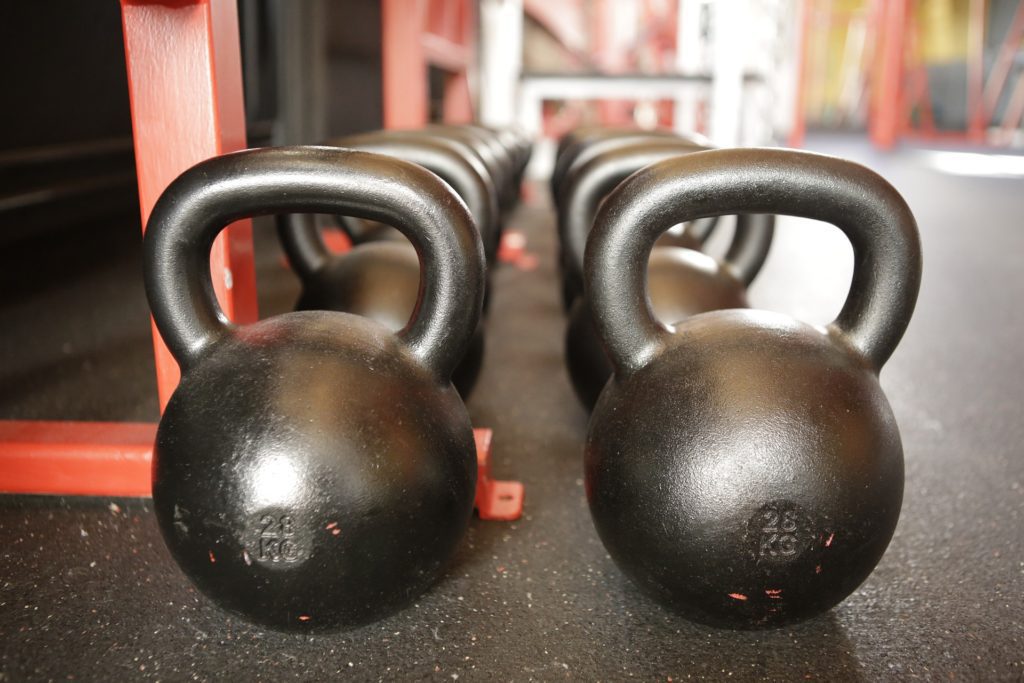
Cast iron kettlebells are popular, and quality ones will last you a long time. High-quality cast iron bells will be single cast and made from non-scrap metal. There are a lot of different types of coating for cast iron kettlebells, including vinyl, epoxy, or powder coating.
I enjoy and recommend the powder coating kettlebell, as it holds chalk better and has a smooth but not oily feel, which helps with gripping and maneuvering.
Pro’s:
- High-quality cast-iron kettlebells will last for a long time.
- Cast iron kettlebells are generally more affordable then competition style kettlebells.
- There are a lot of different coating options (I prefer the powder coat, as it provides a better and more natural feel for your hands).
Con’s:
- Cast iron kettlebells’ coating tends to chip easier.
- Cheaper cast iron kettlebells will have metallic bumps, ridges, an uneven base that wobbles, etc…
Competition Style
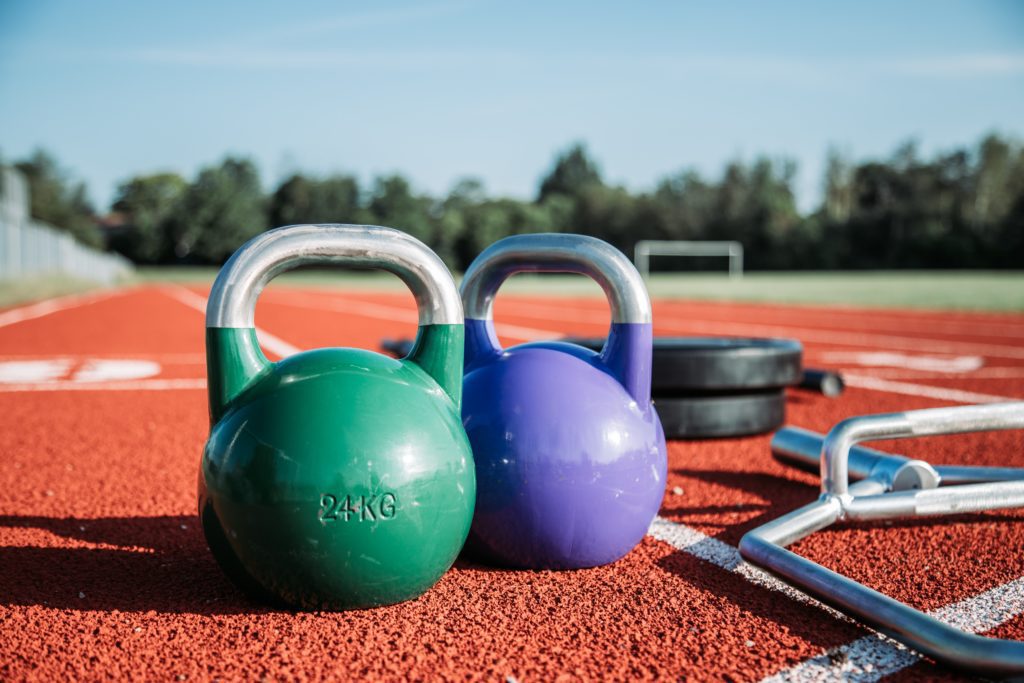
There is an official kettlebell sport, and in this sport, competition style bells are used. They are made from steel and are another popular purchase option.
Pro’s:
- All competition kettlebells at all weights are the same size. This can be helpful when you are learning movements since the size stays the same as you increase weight.
- The base of the competition bell is bigger, which makes movements like renegade kettlebell rows or push-ups on top of your kettlebells easier.
- Using steel eliminates the concern of rusting.
Con’s:
- Price. These tend to be one of the more expensive kettlebell options you can purchase.
Others: Plastic, Adjustable, etc…
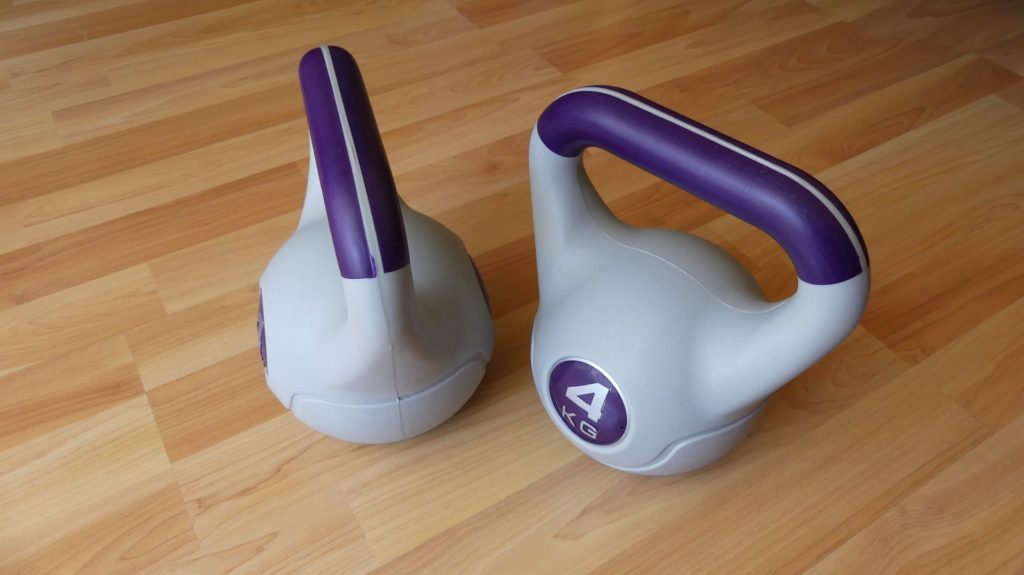
This is where a kettlebell buying guide can help you save time and money. If you are interested in training with kettlebells, I would suggest you start with a cast iron or competition kettlebell and avoid plastic or adjustable kettlebells.
Plastic kettlebells are cheaper, but cheaper can come at the cost of quality. I personally do not enjoy the sharp ridges around the plastic kettlebells, and the cast iron or competition kettlebell will feel a lot better on your hands and forearms.
With adjustable kettlebells, you will need to watch out for clanging or rattling when you move them. And inevitably, at some point in your kettlebell training, you will drop your kettlebell, and it will need to be able to withstand impact to the ground. So, if you go with the adjustable option, be sure to find one that is high quality and won’t break on impact.
What Should I Look for When Buying a Kettlebell?
Finding a quality kettlebell brand is the surest way to ensure that you are buying a quality kettlebell. The company behind your kettlebell purchase is making all of the decisions that go into creating a quality product, and it’s important to find one you can trust.
In the next section of the kettlebell buying guide, I’ll share some thoughts on what to look for in a brand, but for now here are some criteria that can help guide you toward a quality kettlebell:
1. Make
For cast iron and competition kettlebells, a quality kettlebell will be made of iron or steel (not scrap metal), and it will use single casting (not multiple casts with a weld). A quality make ensures durability so that you can get a longer life and use out of your kettlebell.
Kettlebells are an expensive purchase. You might spend anywhere from $3 to $8 per kilogram for a kettlebell, so you want to purchase one that will last you not just months, but years. Putting your dollars into a product that is of higher quality will save you money in the long run.
2. Feel
With feel, this primarily has to do with how the kettlebell horn feels in your hands and how the sides of the kettlebell feel on the backside of your wrist and forearm.
For your hands, you’ll want a smooth horn with sides and curves that don’t have sharp edges or sharp metallic bumps. When you are doing your 83rd kettlebell swing in a row, the feel of the kettlebell horn becomes kind of important, and you’ll want a horn that won’t slice into your hands.
For the backside of your wrist and forearm, you’ll want a kettlebell that has well-rounded sides. Kettlebells generally have their branding and weight stamp on the side, and when you do snatches, presses, or get-ups, that means the back of your wrist and forearm will be rubbing against that branding and weight stamp. The rounder the kettlebell, the better it will feel on your wrist and forearm during those movements.
What Should I Look for in a Kettlebell Brand?
Here are my three “must haves” and my two “nice-to-haves” when evaluating a kettlebell brand.
“Must haves”:
1. Do they have kettlebell weights from light (4kg) to heavy (32kg+)?
Find a brand that offers weights that you can grow with. Once you get used to a brand’s feel and you want to start going heavy, it can be challenging to adjust to another brand’s bell at a heavier weight.
2. Are they committed to product quality?
Are all the cast iron bells they make single cast? Are they all made from scrap metal or the good stuff? Do they offer guarantees or warranties? Price tends to communicate quality, so what do their prices communicate? And, the best way to diagnose quality…
3. Do they have positive product reviews?
This goes without saying, but product reviews tend to reflect how well a company serves its customers, and public product reviews are a way for the consumer to monitor that.
“Nice-to-haves”:
1. Do they sell competition style kettlebells?
A brand that understands kettlebells and its users will know its core customer base might have an interest in competing in kettlebell sport.
2. Does the brand offer some type of coaching or training program?
Offering a coaching or training program tells me that a brand knows its products well enough and cares about its customers to the point that the company wants them to enjoy its products safely and effectively.
Based on these criteria, the brand I recommend and personally enjoy using is Kettlebell Kings.
Started in 2012, Kettlebell Kings is U.S. based business (Texas y’all) and is a provider of high-quality kettlebells, training programs, and accessories.
Here are just a few of the other brands out there:
- Rogue: Started in 2006, Rogue is a manufacturer of strength and conditioning equipment, including barbells, power racks, sleds, kettlebells, and accessories.
- Onnit: Started in 2010, Onnit is a unique company, providing both supplements and what they call “unconventional tools”, such as the kettlebell, club, steel club, steel mace, battle ropes, and more. Founded in 2010, this is a fitness business that does far more than just sell equipment.
- Lifeline Fitness: Started in 1973, Lifeline Fitness has provided professional-grade products for body weight, progressive variable resistance, functional fitness, athletic training, recovery, and yoga.
What Size Kettlebell Should I Start With?
This depends on skill level, experience, strength, etc… But here are some general recommendations.
- For most men, I’d recommend starting with a 16kg kettlebell (adjust to 12kg if you are completely new to exercise).
- For most women, I’d recommend starting with a 12kg kettlebell (adjust to 8kg if you are completely new to exercise).
The most important thing when starting kettlebell training is to learn the form and mechanics of each movement. I’d encourage you to forego starting heavy so that you can practice proficiency with the mechanics of each movement first, and then progress to heavier weights when you are ready. Also, seek advice from your doctor or physician before starting an exercise program, especially if you have pre-existing conditions.
What Weight Increment Should I Purchase Next?
The answer to this question has more to do with your training goals and regimen than anything else. The general rule of thumb is to increase your weight by either 4kg or 8kg increments.
This is where I made my biggest purchasing mistake… I started purchasing lighter kettlebells in 4kg increments without having a clearly defined training plan or goal. So hopefully the next section in the kettlebell buying guide will help you save both time and money in the long run.
How do I get Started with Kettlebell Training?
While this is a kettlebell buying guide and not a kettlebell training guide, before you start purchasing kettlebells you need to identify your goals and plans on how you want to use them. Again, not having a clear plan at the beginning of my kettlebell training was my biggest mistake that cost me both time and money.
Kettlebells are celebrated for their versatility, for good reason. They can help you achieve any fitness goal. Do you want to lose weight? Kettlebells can help. Do you want to build muscle? Yes, kettlebells can help. Do you want to focus on longevity and function? Kettlebells can help. Do you want to strengthen your cardiovascular system? Kettlebells can help.
If I had to do it all over again, I would have made my first kettlebell training goal to develop technique and strength with kettlebell swings and kettlebell Turkish get-ups.
Here’s why and how.
Why swings and get-ups?
Swings are a ballistic movement that builds posterior chain strength and mobility, strengthens your aerobic system, and shreds your core. Get-ups are a slow grind that strengthens every muscle in your body, teaches you balance, and forces you to focus on your breathing while you exercise.
In other words, you get a complete, full-body workout with just these two movements. This not only simplifies your training but also simplifies your kettlebell purchase decision.
With this training goal, you can start with just a few kettlebells. Here are the weight recommendations:
- For guys, you will need 3 kettlebells in 8kg increments to get started. This will be would one 16kg kettlebell, one 24kg kettlebell, and one 32kg kettlebell.
- For women, you will need 4 kettlebells in 4kg increments to get started. This will be one 12kg kettlebell, one 16kg kettlebell, one 20kg kettlebell, and one 24kg kettlebell.
Is there a program out there that focuses on swings and get-ups?
Absolutely. Pavel Tsatsouline wrote his Simple and Sinister Program, which uses these two movements, and will keep you busy for months! The training time only takes 20-30 minutes per day, at about 4-6 sessions per week. The goal of this program is to help you complete:
- Simple Standard: With a 32kg kettlebell, complete 100 1-hand swings in 5 minutes, and 10 get-ups in 10 minutes.
- Sinister Standard: With a 48kg kettlebell, complete 100 1-hand swings in 5 minutes, and 10 get-ups in 10 minutes.
If you want to learn more about this program, you can also read my post on it called the minimalist exercise routine that works.
Just two exercises? That sounds boring…
At first, I thought that too.
What changed my mind is when I tried to do one kettlebell get-up with a 32kg bell… the challenge of just one heavy get-up convinced me that this was not an easy program.
Also, it’s not as boring as having a newly purchased kettlebell sitting idle for months without use because you don’t have a plan. That untouched kettlebell is most definitely bored.
A Kettlebell Buying Guide: Equipment Recommendations
After my own research, experience, etc…, here are the 3 brands of kettlebells I use regularly, and they all sit happily used in my garage. I also recommend having hand chalk and mats for kettlebell training.
The Quality Purchase: Kettlebell Kings (Powder Coat)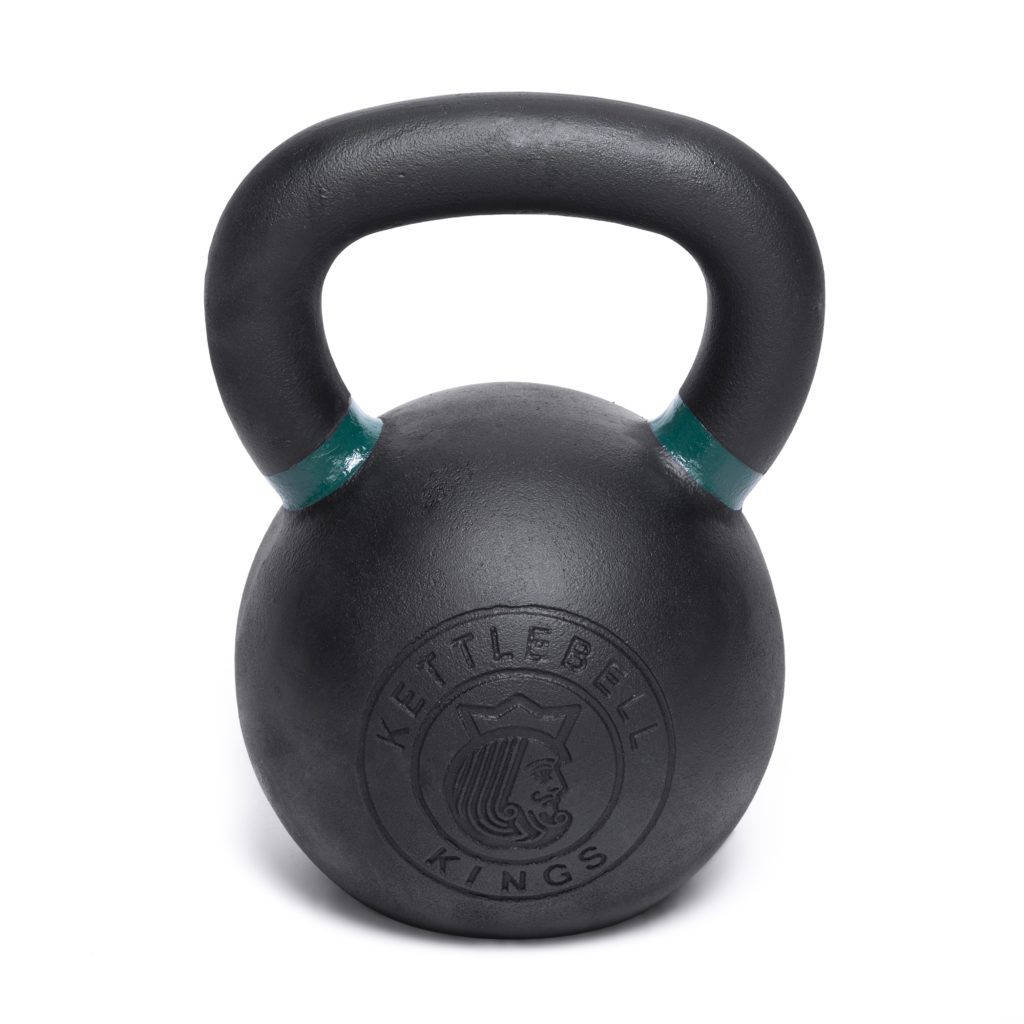
Kettlebell Kings is a U.S.-based business (Texas y’all) that sells premium kettlebells, and their powder coat kettlebells are my recommended quality purchase. This is a premium buy in terms of make, feel, and durability. I have two 24kg, one 32kg, and one 48kg Kettlebell Kings’ bells in my garage.
Pro’s:
- The kettlebell is made from a single piece of cast iron.
- The handle is wide and deep, which makes your hands feel less cramped on two-hand kettlebell swings.
- The powder coating holds chalk better than alternative finishes and feels great for your grip.
- They have all the sizes you could want, starting at 4kg and ending at 92kg.
- The weight-stamped side of the kettlebell is not deeply indented, which provides a better feel on your wrist when you are doing snatches, presses, get-ups, etc…
Con’s:
- This is a pricier brand, but you are paying for quality.
- Oftentimes their heavier bells (40kg+) are out of stock, so be sure to purchase them when they are on the shelves!
The Budget Purchase: Lifeline Kettlebell (Powder Coat)


Lifeline was the very first kettlebell I purchased. After reading through dozens of reviews and comparing prices across several brands, I bought my first kettlebell with Lifeline. For a lower-priced kettlebell, it does the job and I’ve overall been satisfied with it. I have all sizes in 4kg increments from 8kg to 24kg.
Pro’s:
- This is a more affordable purchase. For beginners who want to buy one kettlebell to see if they like kettlebell training, you might want to consider starting with a Lifeline bell.
- The kettlebell is also made from a single piece of cast iron.
- The handle is wide and deep, which makes your hands feel less cramped on two-hand kettlebell swings.
- The powder coating holds chalk better than alternative finishes and feels great for your grip.
- The weight-stamped side of the kettlebell is not deeply indented, which provides a better feel on your wrist when you are doing snatches, presses, get-ups, etc…
Con’s:
- The powder coating is not as durable as the powder coating on the Kettlebell Kings brand. I had a 24kg Lifeline bell that started prematurely chipping and rusting after only having it for a few months.
- The size selection is not as comprehensive as Kettlebell Kings, and the heaviest bell they make is 44kg.
The In-Between Purchase: Rogue Kettlebell (Powder Coat)
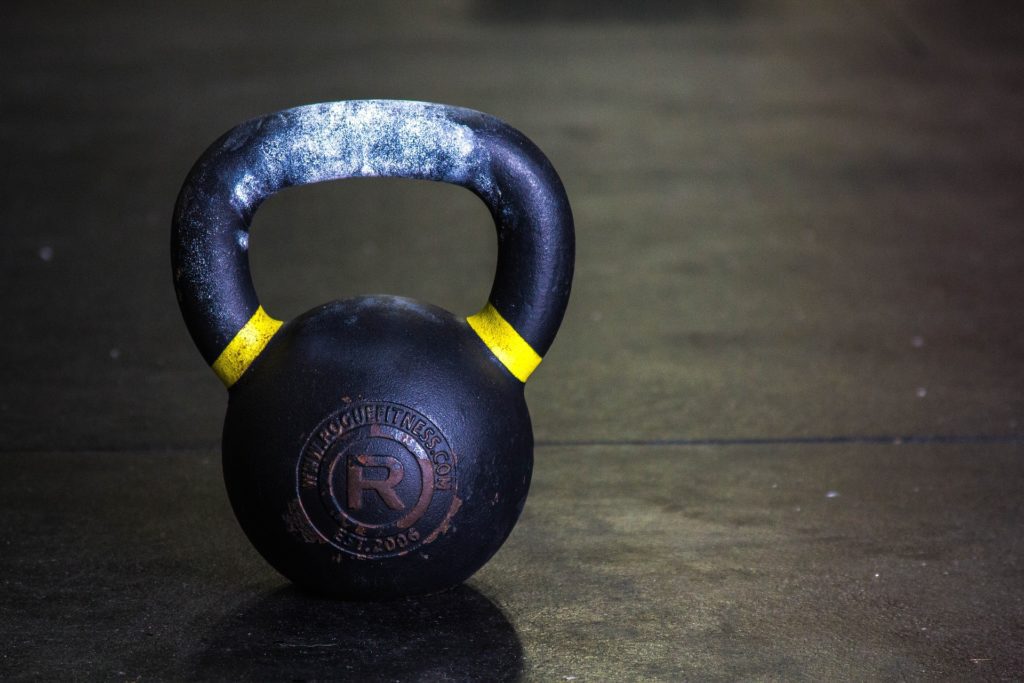
Lastly, if you are looking for an in-between, I’d recommend buying the Rogue Kettlebell. This is another quality buy in terms of feel, make, and durability. I have one 40kg Rogue Kettlebell in my garage.
Pro’s:
- The kettlebell is made from a single piece of cast iron.
- The powder coating holds chalk better than alternative finishes.
- They also have a wide range of sizes, but they are advertised in pounds. They also go from 9 lbs (4kg) to 206 lbs (92kg).
- The weight-stamped side of the kettlebell is also not deeply indented, which provides a better feel on your wrist when you are doing snatches, presses, get-ups, etc…
Con’s:
- The handle is not as wide or deep as Kettlebell Kings, which makes your hands feel a little more cramped on two-hand kettlebell swings.
- The powder coating feels great on your hands but is just a bit rougher than the smoother finish of Kettlebell Kings powder coating.
Hand Chalk: Primo Chalk – Refillable Chalk Ball


Hand chalk ensures that your hands can still grip and maneuver the bell when wet with sweat. I didn’t think I needed chalk until I started doing one-hand kettlebell swings with a heavier bell in the summer. Once I felt the sensation of the kettlebell almost leaving my hands due to the sweat… I quickly ordered this chalk.
Pro’s:
- This chalk comes in a reusable chalk bag that you can refill once depleted.
- This product also comes with a sealed plastic bag that you can store your chalk bag in.
- I’ve been using this same chalk bag for several months and have not yet had to buy a refill.
Con’s:
- The Ziploc-like seal on the plastic bag does not fully seal now after several months. This is not a deal breaker for me (I hardly care), but just something to be aware of.
The Floor Mat: ProsourceFit Exercise Puzzle Mat


Kettlebells are metallic and heavy, and they can damage your flooring on impact, which is why I strongly recommend you purchase a mat to use while slinging bells. Also, if you do kettlebell get-ups you will want a more comfortable surface under your elbows and back. There are so many exercise mat options out there, but these mats are almost identical to the ones that sit in my garage.
Pro’s:
- You can cover a lot of surface area in your garage with these mats for a reasonable price.
- I’ve been able to train both barefoot and with shoes on these mats.
- A quick sweep before and after your workout can help extend the life of these mats.
- My kids really like playing on these mats when I’m not using them.
Con’s:
- On hot summer days during a sweaty workout, my bare feet start to slip and slide a bit while training.
- Sometimes the puzzle seams fall slightly out of alignment through impact, so I’ve had to recalibrate the alignment several times.
A Kettlebell Buying Guide: Instruction, Training, and Program Resources
The most important thing at the beginning of kettlebell training is to learn proper form, and technique and build base strength in the primary kettlebell movements. Here are some resources that can help you.
Layman’s Fitness Hub – Instructional Videos & Programs
The LF Hub is an exercise movement resource library for kettlebell and bodyweight training. There are 15 posts describing each of the primary kettlebell movements, along with detailed instructions, a video, and application ideas. All you need to do is click the “Kettlebell Exercises” tab and start learning!
You can also click the “Programs” tab on the LF Hub or click on these links to the LF 4-Week Kettlebell program and the LF 8-Week Home Gym Strength program, both of which feature the kettlebell.
Pavel Tsatsouline – Simple & Sinister
I’ve already recommended this program, but I can’t recommend it enough. This program really delivers. It just requires two movements (the kettlebell swing and the get-up), each workout takes 20-30 minutes, and it’s a patient but diligent path to building strength.
Pavel Tsatsouline – Enter the Kettlebell!
This was the very first book I purchased by Pavel Tsatsouline, who is often credited as popularizing the kettlebell in the U.S. He provides a lot of great movement instructions and theory in this book, along with a program you can follow.
A Kettlebell Buying Guide: Conclusion
I hope this kettlebell buying guide has been helpful in distilling and introducing you to some of your purchasing options as a kettlebell consumer. The kettlebell is a phenomenal training tool, and I hope you enjoy it as much as I do!
Note – some of these links are affiliate links, and as an Amazon Associate I do earn on qualifying purchases.
]]> Click here to download the 8-Week Home Gym Strength Program.
Why a Home Gym Strength Program?
Ever since I started working full-time after graduate school, I have been obsessed with finding ways to become stronger while working out in my home gym.
My wife and I relocated regularly in the first years of marriage, which meant I had to have a lean and minimalist home gym. My interest in efficient and minimalist workouts at home first led me to bodyweight training, and then to the kettlebell.
Kettlebells are a phenomenal training tool, but they can add up quickly in cost. If you are new to kettlebell training and have questions on buying your first kettlebell, I put together this kettlebell buying guide to help you navigate through some of those initial questions.
This home gym strength program blends together bodyweight and kettlebell training, with the primary goal of building strength at home. For best results, I’d recommend using two kettlebells of the same weight, but you can do this program with just one kettlebell.
The Home Gym Strength Movements
Here’s an overview of the movement selection of this program.
1. The Kettlebell Thruster
Kettlebell training uses a combination of “ballistics” and “grinds”. Ballistics are your dynamic, explosive, and rhythmic movements, like the swing, clean, and snatch. Grinds are your slower, powerful, and steady movements, like the press, Get-Up, and squat.
The Kettlebell Thruster is a hybrid between ballistics and grinds. It pieces together components from the one-hand swing, clean, squat, and press, all in one fluid motion. This movement requires both strength and flexibility, and everything from your posterior chain, legs, core, and upper body is engaged with this movement.
This home gym strength program uses the kettlebell thruster in an interval training structure. You will need two kettlebells of the same weight for the thrusters (for best results), but you can just use one kettlebell.
2. The Pull-Up
Bodyweight training has a myriad of movements you can pick from. You have your reliable Push-Up and its countless variations, the mighty Burpee, and every core movement you could ask for. But nothing builds strength quite like the Pull-Up.
All you need is a pull-up bar and some brawn, and you can build serious strength with a pull-up. The movement engages just about every muscle in your back, your arms, and even your core. This movement does require strength as a prerequisite, but you can regress the movement down into Inverted Rows or Assisted Pull-Ups (with a chair underneath).
This home gym strength program uses the pull-up in an interval training system. All you need is a pull-up bar for these.
3. Double Kettlebell Complexes
Also known as kettlebell flows, kettlebell complexes string together a series of kettlebell movements into a fluid circuit. Kettlebell complexes are a conditioning tool that will elevate your heart rate, test your strength, and build your skill.
There are endless possibilities with building kettlebell complexes. For this home gym strength program, I strung together the push-up, kettlebell deadlift, kettlebell clean, and kettlebell squat. As tough as kettlebell thrusters are, I found that this kettlebell complex is the hardest part of the program.
You will need two kettlebells of the same weight for the kettlebell complexes (for best results), but you can just use one kettlebell.
The 8-Week Home Gym Strength Program
- Goal: Make difficult movements feel easy
- Time: Each session will take 40 minutes to complete
- Skill Level: Intermediate to Advanced
- Frequency: 3 sessions each week
- Duration: This program will last for 8 weeks.
- Modality: This program uses a mixture kettlebell and bodyweight training.
- Equipment: You will need…
- Kettlebells: This program is designed for double kettlebell training, but it can be done with just one kettlebell. Here are links to Kettlebells that I have used.
- Pull-Up bar: If at a park, you can use monkey bars. But if you want one at home, here’s a style that I’ve used for years.
- These are affiliate links, and as an Amazon associate, I earn from qualifying purchases.
- Exercise Instructions: The program pdf has links to the movements on the “LF HUB” page on the Layman’s Fitness website.
One last encouragement – accountability is a catalyzing help for building habits. We all benefit from a community of people who encourage and challenge us to keep pressing forward.
Consider inviting a few of your friends to do this program with you. Doing this program with others will make your experience much more rewarding, and you might find that you will go further with others than you will by yourself.
Questions?
Please email me at [email protected] with any questions on the program. Be strong!
*As always, I’d recommend consulting with a physician prior to starting any exercise plan.
]]>What is an Ab Wheel?
I wish I started incorporating the ab wheel into my routine sooner. This tool takes up only a tiny space in your garage or closet, but it gets the job done in strengthening several parts of your body.
Using the ab wheel will work your full body, but it especially focuses on the:
- Core
- Back
- Shoulders
Let’s jump in!
How to Use an Ab Wheel?
Start on your knees with the ab wheel a few inches in front of you. Position your knees so they are a little more than shoulder-width apart.
Grab the handles of the ab wheel with your hands and position the ab wheel so that it’s directly under your shoulders. Your arms should be perpendicular to the ground. Make sure that your back is not hunched or concaved; your back should be a straight line from your hips up to your shoulders. Once you are in the correct position, inhale.
As you exhale, tighten your stomach, and start to move your torso forward, with your arms leading the way. As you move your torso forward, extend your arms with strong shoulders, until your face is near the ground and your shoulders are by your ears.
As you inhale, tighten your core, and return to the starting position. On the return, it’s important focus on using your core to elevate and retreat your torso back to starting position. Repeat.
This movement takes a lot of practice at first. For beginners, I recommend only rolling a few inches in front of you, then return to starting position. Over time and with practice, build enough strength so that you can roll out and have your face to the ground.
Do it safely but have fun – this is a great exercise!
Where to Purchase an Ab Wheel?
I personally use the following one that I purchased on Amazon.
I really like the width of the wheel on this one. The wheel is not too narrow, and there’s hardly any friction in its movement. It also comes with a small mat (which I hardly use).
This is an affiliate link, and as an Amazon associate I earn on qualifying purchases. But this is the exact wheel that I use, and I hope you enjoy it as much as I do!
How to Program with an Ab Wheel?
Here are some ideas on how you can program an ab wheel.
1. Do an Ab Wheel Finisher
A finisher is just a short sequence of exercise(s) that you add to the end of your workout. And an ab wheel is a great finisher to add to your workout. Do 5 sets of 5 repetitions at the end of your workout. Slowly work your way until you can do 5 sets of 8 repetitions.
2. Add an Ab Wheel as an Exercise in a 5×5 workout
A 5×5 workout, as covered in my post on minimalist workouts, is a circuit workout comprised of 5 rounds of 5 movements. Select 4 other movements, and then add the ab wheel as the 5th movement at the end of the series.
3. Use the movement in a Core Workout
Here’s a very simple core workout that you can do 2-3 times a week, using the wheel:
5 rounds of:
- 5 Ab Wheels
- 15 seconds of Side Planks (both sides)
- 30 seconds of Supermans
This program works your entire core (abs, obliques, lower back), and is a simple addition to your current program.
Trainer Tips for the Ab Wheel
-
Progression (make harder)
- Increase the distance that you roll with the ab roller.
- The goal is to get your shoulders and arms extended, with a flat and strong back, with your face close to the ground.
- Hold your extended position at the bottom for a few seconds.
- Engage your obliques by rolling at angles.
- Roll 45 degrees to the right, then return to the starting position.
- Roll straight, then return to the starting position.
- Roll 45 degrees to the left, then return to the starting position.
- Open your hands while rolling.
- This is the hardest variation I’ve done. Do not try this until you are proficient with the ab roller movement.
- Increase the distance that you roll with the ab roller.
-
Regression (make easier)
- Shorten the distance that you roll with the ab roller.
- Start by rolling only a few inches forward.
- You will notice that you can go further and further with more practice and strengthening.
- Get an ab wheel that has a wider wheel.
- The thinner the wheel, the harder this movement is. The wider the wheel, the easier this movement is.
- Lower your repetition count.
- Practice the Plank movement.
- Shorten the distance that you roll with the ab roller.
-
Application:
-
Complete as a finisher (5 sets of 5, work your way up to 8 reps).
- Add as a 5th movement in a 5×5 workout.
- Use it as a part of a core workout.
-
- Use in Layman’s Fitness Programs:
- 8-Week Thruster Program
What is a Kettlebell Deadlift?
The Kettlebell Deadlift provides the outline for the basic movement pattern of all hinge movements with the kettlebell. It’s a precursory movement that will teach you how to bend at your hips while doing the kettlebell swing, one-hand kettlebell swing, and kettlebell snatch. Increasing the weight and changing your variation will also improve strength, balance, and core strength.
This movement has several variations. For the purpose of this video and article, I will be describing the Romanian Deadlift variation, but I will provide explanations for the other popular forms of the movement.
The Kettlebell Deadlift is a full-body exercise with an emphasis on the following muscle groups:
- Core
- Back
- Shoulders
- Legs
How to Do a Kettlebell Deadlift (Instructions):
Variations of the Kettlebell Deadlift
Like I mentioned previously, there are several different variations of this movement. While I demonstrated and described the Romanian Deadlift variation, here are some of the other forms you might encounter.
1. Sumo Kettlebell Deadlift
For this variation, you will bend your knees more than a Romanian Deadlift. Start by taking a wider stance with your feet, with the kettlebell still placed between your heels. Inhale, and sink your bottom down toward the ground by bending your knees more than you would in a Romanian Deadlift. Grab the kettlebell horn, and as you exhale, stand back up until the kettlebell is off the ground. Return back to your starting position.
2. Suitcase Kettlebell Deadlift
This variation works well for double kettlebell training, but you can do this with just one. Start by placing the kettlebells on the ground outside of our feet. Stand with your feet a little closer shoulder width apart, inhale, hinge down with your hips with your knees slightly bent, and grab the kettlebells with your hands. Inhale and hinge back up, until you are standing upright with both hands holding the kettlebells on the outside of your body.
3. Arabesque Kettlebell Deadlift
This is an advanced variation. Start by standing with your feet together, and with the kettlebell just in front of your feet. As you inhale, take your left leg off the ground, hinge down, and grab the kettlebell with your left hand. As you are hinging down move your left leg back and away from you. As you exhale, hinge up until you are standing upright with the kettlebell at your side. Repeat on the other leg.
The trick to this exercise is foot placement with your foot that’s off the ground. The further that foot is away from your body, the harder this movement is.
Trainer Tips for the Kettlebell Deadlift
-
Progression (make harder)
- Use a heavier weight. Scale up in 8kg increments (16kg, 24kg, 32kg, etc…)
- Do a Sumo Kettlebell Deadlift variation
- Do a Suitcase Kettlebell Deadlift variation with two kettlebells
- Do an Arabesque Kettlebell Deadlift variation
- Do an Arabesque Kettlebell Deadlift variation with two kettlebells
-
Regression (make easier)
- Use a lighter weight.
- Lower your repetition count.
-
Application:
-
Add these as warm-ups. This is great for opening up your hip mobility for a session.
- Add these as an exercise to a kettlebell complex or flow.
-
- Uses in Layman’s Fitness Programs:
- 8-Week Kettlebell Thruster Program
Questions on Purchasing a Kettlebell?
Kettlebells are a phenomenal training tool, but they can add up quickly in cost. If you are new to kettlebell training or have questions on buying kettlebells, I put together this kettlebell buying guide to help you navigate through some of those initial questions. Enjoy!
]]>
Walking barefoot was not a habit I intended to start, but once it was in motion, I wasn’t about to give it up. About a year ago, three things happened simultaneously that changed my feet forever.
First, I was a few months into training with kettlebells. In reading all I could about kettlebell training, I learned that there’s a debate in that fringe kettlebell world over wearing shoes or going barefoot while training. I chose team no-shoes, since I didn’t have to deal with sweaty shoes, or smell the nastiness that is stinky socks (I don’t like stinky socks).
Second, I started a job that was mostly remote work for the very first time in my career. That meant while I could be professional torso and up, my feet were free to roam underneath without the captivity of socks or shoes. I could attend meetings all day at my desk while barefoot and not deal with stinky socks (I really don’t like stinky socks).
Third, because the mostly remote job meant my day was sedentarily spent at my desk, I took walk breaks throughout the day to ensure I was moving. And since I was already walking barefoot around the house, I decided to test it outside. One day in late March of 2022, I took a quick walk around the block without shoes or socks (did I mention I don’t like stinky socks?).
That 15-minute walk turned into a second 15-minute walk later that day. The bottoms of my feet were a little sore after a day of walking barefoot, but I decided to try again the next day. And before you knew it, that second day turned into a week, and that week to a month, and that month to a quarter, and that quarter to a year.
What Do You Mean by Walking Barefoot?
The accepted scientific definition of walking barefoot is:
“the strange phenomenon that occurs when an individual decides to forego footwear and walk around on their exposed and naked feet”
The Google definition shortens and simplifies it a bit:
“walking while wearing nothing on the feet”
The slang for walking barefoot is known as:
And my neighbors who see me walking barefoot around the neighborhood define it as:
“strange, odd, or unusual behavior”
Each of these gets closer to the true definition, whatever that is. But for me, I define walking barefoot as:
“going for walks around the paths and parks near my neighborhood without any footwear”
For clarification, I don’t walk barefoot into Target, Home Depot, church, the office, or other places where people typically wear shoes. On those days and on those outings, I either wear flip-flops or subject myself to the pain of stinky socks at the end of the day.
What I Learned From Walking Barefoot For a Year
Since that day in late March of 2022, I have logged who knows how many miles on the soles of my feet. And what a journey that’s been. Here are some of the strange things I’ve experienced.
My motivation to walk increased
This one surprised me… after a few days of plodding around on my exposed feet, I found that I enjoyed it. And because it was a new thing I was trying, I wanted to get outside and do more of it. I unintentionally found a strange way to motivate myself to walk more.
Even a year into this, the barefoot experience still has some novelty. And the step count on my pedometer thanks me for that daily, as I’ve been able to get 10,000 daily steps regularly, even with a sedentary job.
I cannot recommend the pedometer I use enough. It’s a watch, and I’ve had it now for several years.
This is an affiliate link, and as an Amazon Associate I earn on qualifying purchases. But unlike your feet, you should cover up your wrist with something that will help you track your steps.
My feet don’t stink as much anymore
Do you remember the scene from the movie Holes where Stanley’s mom is asked by her husband to smell the pair of shoes while she’s eating? After being disgusted, she takes a sniff, says “I don’t smell anything”, and then realizes she just had a life-changing experience.
Well, I guess I had my own Yelnats moment with my feet. After a few months of not wearing socks or shoes while walking around my neighborhood, I remember sitting down one day with my feet propped up on the coffee table, and I noticed that I didn’t smell my feet at all.
That thought quickly entered and exited my mind. Then I realized that my feet don’t stink. I bolted upright, pulled my feet in for a close sniff, and to my shock they didn’t stink at all. Normally, after a long day of wearing shoes and shocks, I like to keep a far distance between my nose and my feet. But after months of walking barefoot outside, there wasn’t a smell.
I asked my wife, who was nearby, to smell them. She politely declined a close-range sniff, but she did tell me that she had definitely noticed that my feet don’t stink as much.
Walking barefoot was my peaches and onions.
My toes are not as curled
Curled toes run in my family. I always thought I was destined to have toes that looked like gnarly and bent claws toward the end of my life. But I think I’m delaying or reversing that process by walking barefoot.
When you walk around in footwear (especially with narrow or smaller shoes), there can be slight resistance that’s applied to the tops of your toes that force them to curl inwards. My genetics already predisposed me to have more naturally curled toes, so even in my late twenties my toes were curling like an Olympian.
But when I started walking barefoot, my toes had room to spread. Again to my shock, my toes not only stopped curling as much, but they started to elongate more naturally. Hopefully, I’ve reversed the curse of curled toes in my family.
Watch out for things hidden in the grass
By far the number one question I have gotten from people who see me walking barefoot is related to safety. Is it safe? Aren’t you going to step on something? What about glass or nails? What about fungi, bacteria, or infections?
After doing this for one year, I have never cut my foot open nor have my feet been infected. But there was one time I did step on something memorable.
I was earthing that day. I decided to leave my well-trodden bicycle path for the feel of the dewy grass.
It was a great walk. The sun was out after a long night of rain. The temperature was cool. The grass on my feet proved to be softer and more comfortable than the pathway. My dog, who was with me, seemed to enjoy company on the grass as he and I made our way towards our destination.
That’s when I stepped into it. And I knew exactly what it was when I felt it squish between my toes. Someone had not fulfilled their neighborly responsibility by picking up their dog’s mess, and I had stepped right into it.
I was about a mile away from my house… so I wiped as much of it off my feet as I could in the wet grass, and hobbled my way back home. That was the last time I left the safety and security of the path.
The bottoms of my feet are tough as steel
Well… not quite. But there’s definitely a thick layer of protection on my soles that wasn’t there before. I also have veins and muscles on my feet I didn’t know I could have on my feet.
The way your body can acclimate to its surroundings, even in the forgotten-about underparts of your feet, is remarkable. The bottoms of my feet have adapted to the regular impact of hard pavement, ground, small rocks, and whatever else is on the pathways in my neighborhood.
In terms of temperature adaptations, I live in southeast Texas. We don’t really have a “winter”, so I was able to keep up this barefoot walking thing through the colder weather (with some exceptions on the really cold days!). But our summers can be brutal, and the pathways can be painfully hot. I avoided walks during the extreme temperatures of the day, but in the mornings and late evenings, my feet were able to adapt just fine to the warmer paths caused in the summer months.
Is Walking Barefoot Actually Good For You?
I probably should have asked this question a year ago. But here we are, one year and one blog post later.
I’m not going to make a claim one way or the other on if you should do it too. Most of the research I’ve read on walking barefoot adopts a “sure you can do it, but use some common sense” approach. But I do think letting your toes out every so often won’t cause any harm. You might actually like it.
Hopefully, you’ve sensed that I’ve been using humor throughout this post to tell my story. But I actually have been walking barefoot for a year, I actually have really enjoyed it, and I plan to continue walking barefoot this year.
This year I also plan on doing some research into the “barefoot shoes” world. But you likely won’t catch me wearing socks.
]]>